

Interview: Phil Thornalley
Discussing His Storied Music Career & New Album 'Stacked'

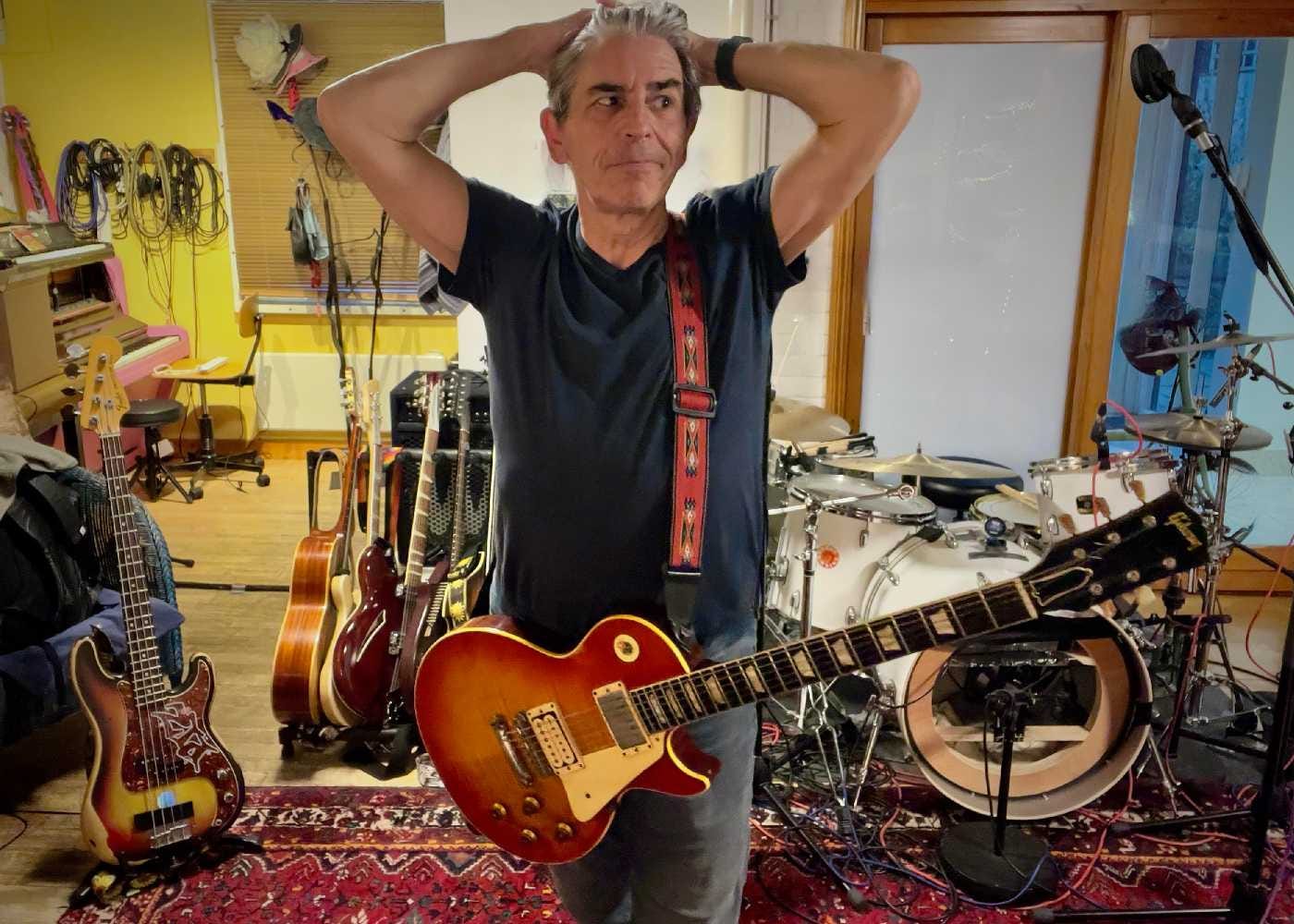
Phil Thornalley’s incredible behind-the-scenes music career is the fantastic fodder for his new solo album.
Thornalley produced The Cure’s 1983 album Pornography and briefly joined the band as their bassist. In the ‘90s, he co-wrote the song “Torn,” first recorded by Ednaswap and later turned into a Thornalley-produced international hit by Natalie Imbruglia. He has also worked as an engineer, mixer, and producer for a long list of other notable bands including The Psychedelic Furs, Duran Duran, XTC, and Ash.
“I’ve been making music since I was 13, playing in bands, writing songs. I started working ‘professionally’ at a music studio at 18, straight from high school, working for the music business impresario Mickie Most,” Thornalley told me for the interview below.
Thornalley has also sporadically released solo music over the years, under his own name and as Astral Drive.
His latest album is the pop punk homage Stacked, a long distance London-to-Los Angeles collaboration with vocalist Casey Shea. Other Stacked collaborators include Graham Gouldman (10cc, Wax) and Shelly Peiken (co-songwriter of hits including "What a Girl Wants" by Christina Aguilera and "Bitch" by Meredith Brooks).
The album features the tongue-in-cheek debut single “Chorus Goes Here,” the perfect entry point for this playful and rocking collection. Thornalley wrote the song years ago, but never found the right artist to record it—so he did it himself.
“I’ve been a songwriter and producer for hire and it suddenly seemed like it would be a shame if people didn’t hear this ridiculous, partly autobiographical song based on my years in the music business,” Thornalley said. “Kind of archly commenting on the difference between music and the music business.”
I caught up with him by email to discuss the writing and recording of Stacked, some of the influences and inspirations for this collection, his thoughts on AI in music and marketing, and much more in this in depth interview.
Congrats on the fun new album! What was your inspiration to record this infectious, tongue-in-cheek collection?
Phil Thornalley: I’m happy to say I’m inspired to make music most days and since I don’t really professionally write and produce for other artists anymore, I habitually create music for myself. For instance, if i’m watching a ‘soccer’ game on the TV I’m usually playing a bass in my armchair at the same time and often laying on ideas I like.
Sometimes in these unconscious moments, whilst my attention is diverted, some bass line will appear. Or an ear-catching (to me) chord progression, and then I find myself humming a vocal melody…maybe even finding a title or a lyrical theme. It’s a lifetime affliction! So, the inspiration is always there, standing at the toaster in my kitchen. Where the work starts for making an album is the process of sifting through the good ideas from the bad ones. Got plenty bad ones.
I pay attention to the moments when the unconscious bleeds through—in dreams, in daydreams, in journeys on public transport, walking, playing football, when most of your anxious mind is engaged in another activity.
Is that how Stacked came about?
Phil Thornalley: For Stacked I listened back to a couple of older songs that I had forgotten. Funny, catchy songs from my past that were written in that Weezer/Blink 182 style (pop melodies with playful, often teenage-based lyrics about high school romance, etc.).
So, I imagined myself as being the leader of a band 40 years younger than my physical chassis. One song, ‘Chorus Goes Here,’ had an arch lyric about the jeopardy of a young band signing to a major label and then finding out the label didn’t hear a hit so were going to coerce the band to find one. The irony being that as a songwriter-for-hire I would often work with signed ‘artists’ who the A&R were farming out to people like me to try and come up with a suitable hit song. Pretty much the only writer who realistically knows how to do that, seemingly effortlessly, is the Swedish maestro Max Martin (Backstreet, Britney, Coldplay, Taylor Swift, et al.).
“Unless you’re sincere, I believe the music won’t work. It’s the balance of the sincere and self-referential that’s key. For me it doesn’t work unless the tunes are strong and can stand some teasing.”
I’m overt about my inspirations since they’re often other established artists. For my Astral Drive albums they are my homage to my (unknowing ) musical mentor Todd Rundgren (who incidentally made some fine power pop earlier in his career). His music was my musical education since I’m self-taught and in the days before ‘tabs’ I learned about chords from teaching myself his sometimes complex piano-based tunes.
With Stacked it was more about my own take on that SoCal Weezer vibe...peppy tunes, humorous lyrics, and a ‘59 Les Paul thru a Marshall stack.
You got me hooked with “Chorus Goes Here.” If you told me that was from an early 2000s Warped Tour comp, I’d believe it. What made you go in that stylistic direction?
Phil Thornalley: Once I’d uncovered that song, I asked my friend Casey Shea to come on board as the lead vocalist to give it some real appropriate South California vibes with his outstanding voice. Once that was in place—the sound of Casey and the rock production—it became the template for the rest of the album’s songs: an ironic look at the world, or in some instances, songs that I thought that I’d already written that I thought could handle a shake up in that production style of late ‘90s/early 2000s Weezer/Blink 182 sunshine vibe. Two guitars, drums, and bass.
It also helps that a music biz mogul, an acquaintance, recommended the mixer Chris Dugan (Weezer, Green Day) to finish the record in style. Chris’s mixes sound massive. Everything’s massive. The drums, the bass, the guitars, the singer. Everyone’s louder than everyone else.
That one—and other tracks such as “Four Letter Word,” “Parents,” and “I Dig Rock Rock n’ Roll”—strike this interesting balance between homage, irony, and self-indulgence. Does any of that resonate?
Phil Thornalley: That’s pretty funny. The balance between homage, irony and self-indulgence. It definitely resonates because it’s somewhat ridiculous since I’m no longer a callow teenager that loves music, but a somewhat older teenager in spirit.
Pop music is principally for teenagers rebelling against their parents and since I’m more of a parent than a teenager—in order to sing those songs—it’s got to be done with with tongue-in-cheek humor. When I say ‘sing,’ I mean my pal Casey Shea actually sings—I play the guitar, produce and write most of the songs with some cowriters, but I’d like to think the whole record is…certainly self indulgent, and hopefully funny, even the ballad “It’s You That I Want,” which was originally written for Celine Dion. (BTW: If Celine would like to record the song, or any other multiplatinum ballad singer, please go right ahead.)
“Parents” lands perfectly for me. The mix of homage, irony and self-indulgence is just so. Someone said it’s like Ramones meets Malcolm in the Middle. “I Dig Rock N Roll” was originally written as an idea for Bryan Adams to consider. I used to play bass in his band and we’ve written 20 songs over the years (all recorded by him or other artists), but Bryan demurred so I changed the lyrics into a riff on my personal rock and roll tastes. “I love Led Zeppelin ’til the singer comes in,” is, as I’ve mentioned before, a personal opinion that I enjoyed including in a song. Also, “Get your Jimmy Page on,” meaning play your guitar with spirit and abandon.
In describing this album to friends, I’ve taken to calling it a mix of snarky pop punk in the vein of Nerf Herder or Bowling For Soup with the pure rawk bliss of Marvelous 3 or The Darkness. Does that land?
Phil Thornalley: Firstly, can I say the fact that you’re describing this album to your friends is a major coup in itself. To engage and have people talking about the record is so important to me as an unknown artist. Not only does it land, it takes off with those references.
The references to the band Bowling For Soup and The Darkness accurately define or describe this kind of ridiculousness (another word might be ‘camp’ or ‘kitsch’). There’s a favorite saying of mine—I’m not sure if it’s an urban myth—but I heard it said about Todd Rundgren by a producer: “If it’s worth doing, it’s worth overdoing.” If you think of the Meatloaf record Bat Out of Hell, that makes sense. Take a concept and go over the top.
“Weezer and Fountains of Wayne have always been ‘go to’ artists for me—the college brat attitude, the witty artistry and sly humor of Steely Dan but with dumb guitars and deceptively pure power pop melodies instead of five note jazz piano chords and slick grooves.”
Certainly part of that resonates in my career as a producer. You want to carve out a sound that makes someone’s head turn, but, you know, in a contrived way, engage with the listener. You also want to have the listener be aware that it’s tongue-in-cheek and funny. A way of doing that in my production is to be heavy handed with the drums or the guitars or the singing—heavy handed and overblown with everything—that’s the Stacked album!
Casey’s vocals are, to me, committed, earnest and funny. The lyrics are meant to be funny. Casey’s delivery was on the same page as my concept. He’s delivering the songs in this mocking style, with a kind of self indulgence, which kind of resonates certainly with The Darkness, where they’re paying homage to a style of rock and laughing at it but at the same time—most importantly—loving it. Unless you’re sincere, I believe the music won’t work. It’s the balance of the sincere and self-referential that’s key. For me it doesn’t work unless the tunes are strong and can stand some teasing.
What made you decide to use an A.I.-generated video for “Chorus Goes Here”? Was A.I. used in the songwriting/production of Stacked?
Phil Thornalley: So, to answer the second part of your question—no AI was used in the songwriting and production of Stacked. I have a couple of friends who have used it on their records and I’ve heard records on the radio that I’ve thought sounded too good to be true, but I guess as the technology is refined then maybe in another 18 months’ time that may not be the case.
I used the AI generated video for ‘Chorus Goes Here’ simply because I have a limited budget. A learned friend of mine said, ‘Why don’t you use this app?’ and, for a few hours, I kind of got the hang of it generating these five second clips. All my prompts were to do with literally interpreting the lyrics of that song, because I wanted people to get the joke of the ‘Chorus Goes Here,’ that it’s about the music business and, you know, like ‘working for the man,’ if you will. So, I would prompt a scene that I imagined would demonstrate each couplet of the lyrics. It was quite hit and miss.
Luckily, my friend AC, Head of LoJinx Records (a power pop label that you may be maybe aware of), is an excellent video maker and editor. So, he took my 50 crappy five second clips and said, ‘Can you do another 50?’ He then edited my crappy 100 clips cleverly and imaginatively into a punchy three minute visual. There’s a kind of a resonance with the song talking about the manufacture of music and you’re actually manufacturing a picture to go with a song that’s talking about the manufacturing of music. So, maybe that’s ‘meta,’ which seems to be a word that’s bandied around.
AI allowed me the opportunity to realize some things visually that I thought were funny and might be arresting and were appropriate to a perhaps overly literal interpretation of the song’s lyrics rather than, you know, a new 2001: A Space Odyssey.
So, getting back to your point about AI—I used it for my video because I had a minimal budget and thought it was a way to market the album, to try and reach more people Realistically, the use of AI to make the video was in fact—for both of us—a perfect solution to me being in London and Casey 6000 miles away in Los Angeles.
My music friends and I often debate the shades of gray between using A.I. for music and using it for marketing. Given your wealth of experience, where do you draw the line (if you do)?
Phil Thornalley: This is a very cynical line when you’re talking about using AI for music and using it for marketing purposes. There are a couple historic phrases that comes to mind, both horrible: ‘It’s for selling, not for listening to;’ and equally, ‘There is no selling out; There is only cashing in.’
But I have heard executives and managers mention those phrases in a knowing sarcastic way, when, for instance, I’m working as a songwriter/producer and complaining about why my track—my perfect song—ended up as track 7 or 8 on this or that album, when of course it deserves to be the first single!
The more cynical music business reality would be, ‘Well, it got on the album, maybe you got paid for producing it, so don’t complain.’ In reality, you know you’re lucky you’re on the album because there are another 50 songwriters who were trying to get on the album. That’s still goes on.
It’s crazy, though. I never understand that for last 30 or 40 years it’s called ‘pop music’ and yet labels sign an artist and then spend two or three years ‘developing’ them (i.e. writing hundreds of songs with people like me), and the whole reason it’s called ‘POP’ is because it’s instant, right? Because it’s happening now.
It’s like you open a bottle of Coca-Cola and it starts fizzing, right in that moment. If you’re writing something that you think is kind of pop and fizzy, and then it comes out two years later, guess what? It probably sounds a bit flat.
The Stacked track I’ve come back to most often is “Pleasure’s All Yours,” which is the perfect mix of The Cars, Weezer, and Fountains of Wayne. Would you consider those acts guiding stars for Stacked?
Phil Thornalley: Those references were all in my head when the song was written. The naff synth melody is definitely nodding affectionately to The Cars.
For that song, my neighbor Graham Gouldman sent me a demo track with the chord progression and I had a title ‘The Pleasure’s All Yours’ lying around, which seemed to fit. We decided to make the ‘singer’ a character, a conceited rock star with an entourage and an appalling vanity.
Weezer and FOW have always been ‘go to’ artists for me—the college brat attitude, the witty artistry and sly humor of Steely Dan but with dumb guitars and deceptively pure power pop melodies instead of five note jazz piano chords and slick grooves. (For the record, I never attended a college. Let’s say academia suffered as my interest in self-taught songwriting and sonics bloomed.)
I was caught off guard by the Neil Diamond medley in the midst of this ‘90s/’00s pop punk extravaganza. What inspired that mash up?
Phil Thornalley: My eternal search for the ridiculous. I’m a fan of Todd Rundgren who made some mind blowing albums in the ‘70s that included reimagined peyote button inspired covers of Smokey Robinson and Curtis Mayfield songs. Acid Soul!
I’d like to think I was approaching those classic, perfect pop Neil Diamond evergreens with the same lack of respect for the style, but with huge respect for the song.
You finish the album with “Hold Me,” which is stylistically more in line with ‘60s British Invasion and ‘70s glam to my ears. Did you take a different approach to writing or recording that one?
Phil Thornalley: I was trying to capture a last chance, burn out, chaotic vibe. So, the playing is very loose all round. I hired the superstar drummer Ash Soan to play drums and asked him to play with full chaos (too many drum fills, anywhere—“If it’s worth doing; it’s worth overdoing”). That’s what came to mind.
It’s a kind of goodbye; we’re never doing this again so let’s enjoy it whilst we’re here.


