

Interview: Vegas With Randolph
Discussing The Band's Recent 'Best Of..." Collection

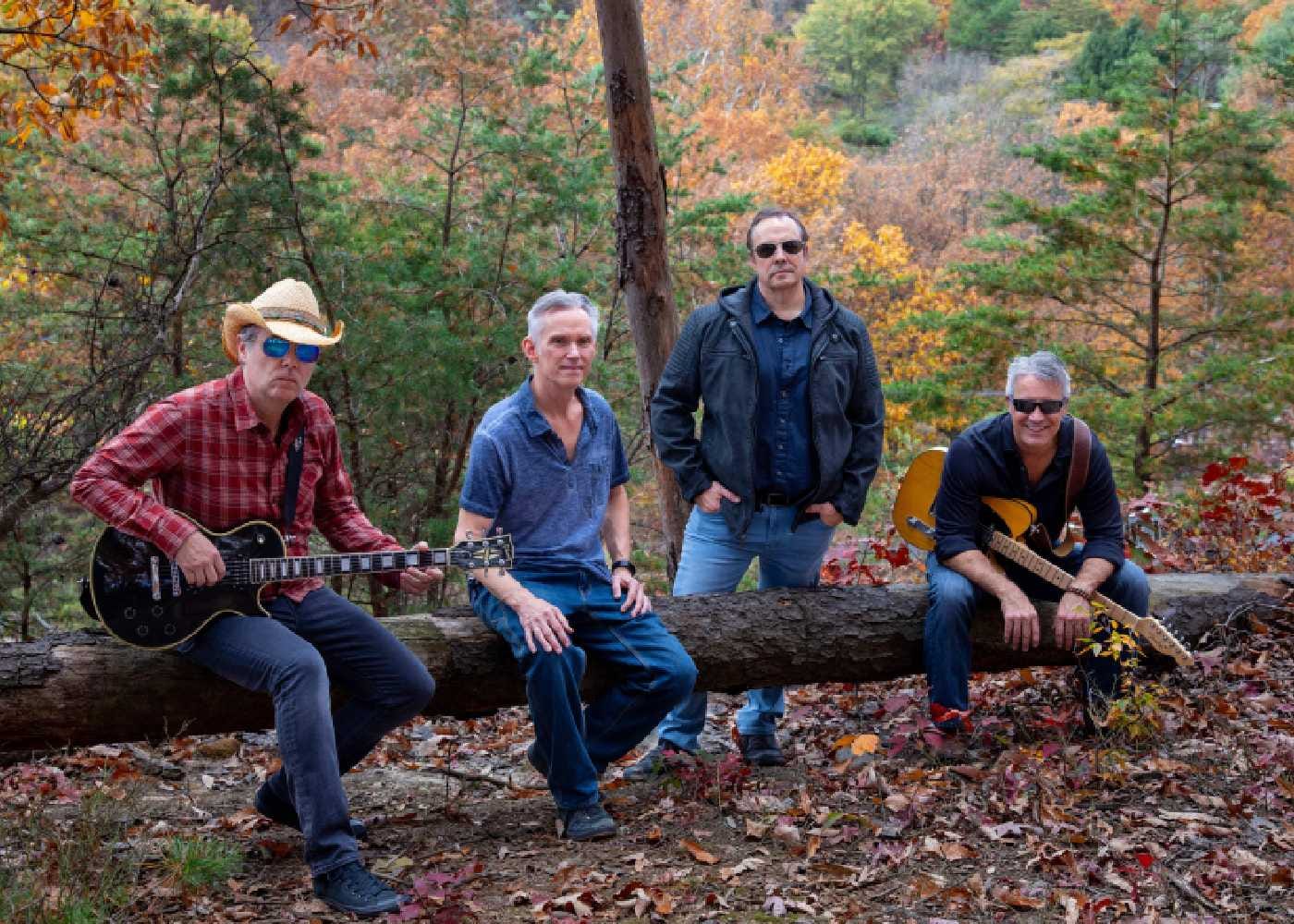
An indie rock band with a quirky name, high-energy sound, and hooks for days? Sign me up.
It’s okay if you aren’t already familiar with longtime Washington D.C. outfit Vegas With Randolph. Their recent “Best Of…” release, Drops Of Gold, is the perfect way into their impressive catalog.
“We are genuinely very proud of the quality of our output and songwriting across the years. The fact that a 24-track ‘Best Of…’ still didn’t feel like enough songs—which we fully admit sounds a little ridiculous—is really a testament and reflection of that,” said Eric kern (vocals/keys/bass).
Drops Of Gold arrived with a brief documentary about the band’s two decade career.
“It’s satisfying to have delivered 5+ albums in the spaces in between other things like families, day jobs, and life. The nostalgia of the body of work is focused when you pull pieces together and collect them,” said John Ratts (vocals/guitars).
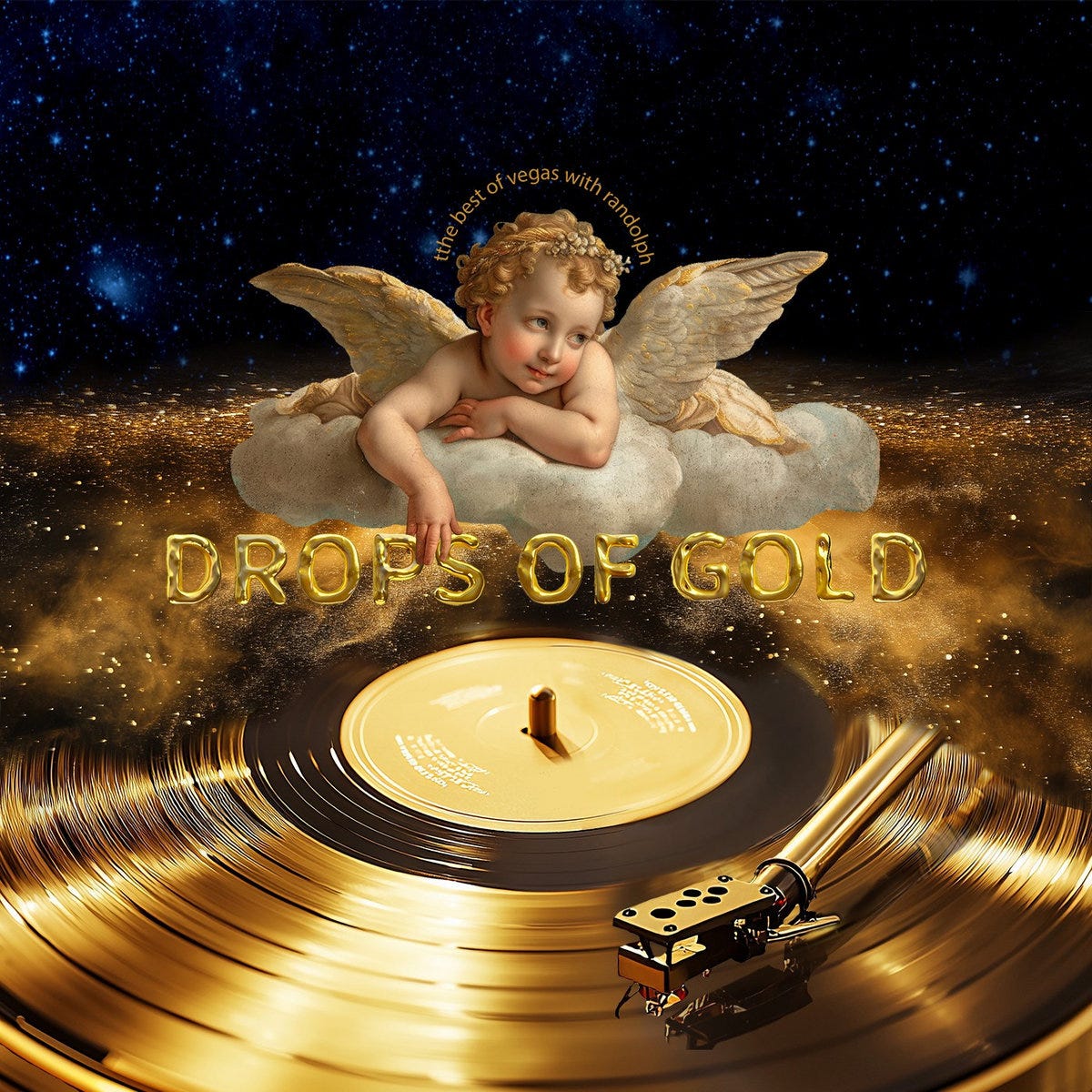
“We spent time on the artwork to highlight the ‘accomplishment’ of the effort and results. We hope people continue to enjoy our songs long after their debut.”
I caught up with Kern, Ratts, and David Purol (guitars) to discuss Drops Of Gold, what it took to deliver this new collection, and what’s next for Vegas With Randolph.
Vegas With Randolph Interview
Congrats on Drops of Gold! Can you tell me a little about how this career-spanning retrospective came together?
Eric Kern: Fans, friends, and the band had been asking for VWR on vinyl for a long time, especially around the time of the Rings Around the Sun release (whose cover literally featured a large galactic record spinning). It was hard not to think about that format, so pressing vinyl became a goal. Then, as vinyl enthusiasm kept growing through the 2020s, we knew the time had come—but which of our five albums would we press? Choosing just one meant leaving out some essential VWR tracks, while pressing all five was… financially ambitious. So, the idea of a ‘Best Of’ double LP felt like the right balance: a single collection that brings together a lot of the band and fan favorites. It also gives first-time listeners a way into the VWR collection all at once, while letting each individual album on CD remain its own distinct, special thing.
John Ratts: Remember the Columbia Record House record clubs? You sign up and pick like a dozen albums for a song and then cancel because you are (to quote Fountains of Wayne…) “strapped for cash.” It was always economical to get the greatest hits albums for artists you liked but didn’t love. They were fun to listen to because each song was great. I can recall Steve Miller putting out Vol. I and Vol. II close together. After 5 albums VWR deserved a ‘Best Of.’ If you are patient, there could easily be a Volume II in the coming years.
Was it difficult to decide which tracks to include and not include?
Eric Kern: Many tracks felt obvious to us—songs that had received strong feedback over the years, staples of our live shows, and those that clearly had momentum online through videos and streaming. Beyond those, though, there were dozens more that could’ve found a great home on this collection, and narrowing it down to 24 tracks for vinyl was actually pretty tough. To aid with this, we ran a fan survey in January 2025 asking fans and music industry VIPs to weigh-in on what they thought were the most essential VWR tracks. In the end, the results lined up fairly well with our instincts, but in a lot of cases they helped us make the final call between one track and another.
That’s also why we included a few additional digital bonus tracks. And we knew we wanted at least one brand new song and one ‘rare, unreleased’ vintage track—hence ‘Perfect Silences’ (the newest VWR track from our 2025 sessions) and ‘New Leaf,’ an unreleased cover from a private 2016 recording collection.
Why was “The Better Part” the right opening track?
Eric Kern: While putting together the Making Of… documentary video, Brock Harris (lead guitar) commented that ‘The Better Part’ was one of the first truly defining tracks where the full VWR lineup contributed and the band’s sound really came into focus. It opens our 2011 album Above the Blue and still sounds fresh, touching on a lot of what we think VWR does best. It was also named ‘Song of the Year’ by Sacramento’s Twirl Radio when it was released and has often served as the closer at our live shows. So, it felt right to kick off Drops Of Gold with it.
Did this release give you any new perspectives on Vegas With Randolph, your legacy, and what you’ve achieved?
Eric Kern: Much of this material abundance comes from having four core composing members with strong creative instincts and an equally strong sense of what it takes for a song to make the cut. While John and I have been writing together consistently for decades, Dave Purol has also been contributing standout material—songs like ‘Salt Water Taffy,’ ‘My Lost Colony,’ and ‘Show Me How,’ which are among VWR’s finest. Brock’s melodic guitar creativity and ever-expanding compositional ideas have shaped and elevated the VWR sound from the very beginning, and that influence keeps growing. You can particularly hear it in some newer recordings, like the intro to ‘What If’ on The Future Store, and in several full compositions already underway for album number six.
Dave Purol: These songs were chosen by the fans. In that sense, it reflects the listener’s perspective: those songs people actually enjoy coming back to, whether that’s the lyrics or the musical backdrop—including those ‘crackling guitars’ (a subtle nod to our predecessor band, Euphoria). For me personally, my proudest moments have been writing and contributing my own songs and adding more vocals. (Guitar lines and solos are the easy part!)
Your sound has been compared to Sloan and Fountains of Wayne, among other power pop legends. Would you consider those artists influences? Who else?
John Ratts: Absolutely, yes. It is such a great feeling to be compared to these great bands and songwriters. We do try to do our own thing and have our own style that is an integrated collection of each of VWR’s band members. Who else? The Beatles, America, Al Stewart, Steve Miller, James Taylor (but with more guitar)….
Eric Kern: We see those artists as both influences and peers. They, and VWR, came up drawn to a similar lineage of music from the ‘70s, ‘80s, and ‘90s, and we all approach songwriting in comparable ways: taking those early influences and filtering them through a ‘90s and 2000s sensibility. So, it’s no surprise we fell in love with their music even while we were busy writing our own.
That blend of energy, catchiness, and cleverness was a big reason we connected with FOW right away, starting with their first album—though they’re far from the only band in that camp we relate to. The Midwestern upbringing of our core members (all four of us spent formative years in Illinois, Indiana, or Missouri before relocating to the DC area) brought early exposure to power pop and pop rock bands like Cheap Trick, Boston, and America. Layered on top are The Replacements/Westerberg, Soul Asylum, R.E.M., and a wide range of influential songwriters—from The Beatles to Paul Simon, Don McLean, Warren Zevon, Leonard Cohen, Rhett Miller/Old 97’s, Jonathan Coulton, and more. More recent punk pop bands like Bowling for Soup, Weezer, The Menzingers, and FOW continue to inspire us to want to write more great, fun, energetic music. And of course it was a total thrill for us to have FOW’s Jody Porter, and other great artists we admire, sit in on some VWR tracks.
Is Vegas With Randolph a power pop band by design?
John Ratts: Yes. Our first album was a pretty much a start. In between it and Above The Blue we discovered the label for the genre we were already doing and decided to more formally embrace it and deliberately write a set of songs strongly in that vein. Above The Blue was the result and it was very well regarded by fans of the genre, and very enjoyed by us, so we continued with it—varying at times for specific songs that we wrote, liked, and lent themselves to another style. Drums, guitars, and melodies. How can you go wrong?
Eric Kern: I agree. We deliberately decided to embrace that description of our music when we first started hearing it around 2009—but I’d also argue it was kind of inevitable. Growing up on ‘70s and ‘80s Midwest AM radio wires that sound into you a bit. We just wanted to do what we loved. Nearly two decades later, we’re still doing exactly that, and honestly, we’d recommend it.
You’ve also been called “thinking-man’s party music.” Can you tell me a little about the kind of party the writer was describing?
John Ratts: Like George C. Marshall, I’d rather leave characterizing VWR to others—but in the spirit of his three-day interview (as I recall), for history and posterity I’ll say: We tend to write songs about the ideas that lunge at us and work to make the lyrics meaningful. If you start with a serious, or a fundamental-to-the-human experience theme, the lyrics tend to stay true to themselves (unless you work hard to change them). So, the ‘party’ would maybe be one for no reason that starts with cocktails, then turns to a dinner party discussing existentialism and the meaning of life, and then devolves into a milling of characters with everyone responsibly driving home or sleeping it off overnight on the couch—with the common denominator of a fun time had by all and in their own idiom. Oh no! I broke my George C. Marshall rule…
Eric Kern: Ha! I’m not exactly sure what party John is picturing, but I definitely call the couch. I always assumed that ‘thinking-man’s party music’ line meant something like: VWR makes upbeat, fun music that works perfectly as party atmosphere—but once the crowd clears out and you actually listen to the words, there’s usually something going on under the hood. Maybe it’s thoughtful, clever, or maybe it’s just relatable; if not always earth-shattering, we’re always trying to say something worth thinking about.
I have to ask about your band name, which is right up there with the quirkiness of Fountains of Wayne in my book. Any backstory there?
Eric Kern: ‘Randolph’ is one of the oldest friends John and I have. We all grew up together in our central Illinois hometown, and Randolph still lives there. A few years back, our old friend group planned a reunion ‘guys getaway’ to Vegas… which, alas, completely fell apart. That almost-trip—with Randolph at the center of it—became a fabled ‘Great Misadventure That Never Was.’ This all happened just a few months before our first album came out, and the idea of those great times that might have been turned into a kind of metaphor for some of the spirit we wanted our music to capture. That hope of finding small, fleeting amazing moments of joy tucked inside the everyday.
I’ve had “Julianne” on repeat. What’s the story behind that track?
Eric: Song ideas for us usually fall into one of two types—the first is the intentional idea song,’ like a ‘Snow Day’ or ‘Lagavulin for Christmas’ where there’s a strong driving idea and lyrics often seem to script themselves in support of that. Another approach, more often mine, comes from a less concrete and more emotive place based on moods discovered in certain chords or rhythms that sometimes pull the writer down unexpected rabbit holes. In those cases, the lyrics feel discovered rather than planned, literally emerging with the first vocal line as it’s sung—the convergence of mood, music, and words.
‘Julianne’ came together in that second way, and ultimately became a reflective piece that respectfully mourned and honored a bygone era and relationship. Like ‘The Better Part’ earlier and ‘A Pretty Good Run’ later, this overlap of melancholic reminiscence with some recognition of gratitude seems to find an emotional sweet spot for us. Despite some inherent imperfections perhaps, we are still, ‘Writing you a song for those things that were strong’ and ‘those things that we got right, are the finest things in life.’
I’m clearly a sucker for songs with girl name titles. What can you tell me about “Marisa”?
John Ratss: Everyone loves Marisa Tomei. She is the girl next door, for sure. My favorite Marisa movie is Happy Accidents, but this song was inspired by her movie Wild Hogs. After watching that movie the idea of being infatuated with a movie star took hold and if you go deep, a benign obsession may just be as good as the real thing. I think the song’s popularity is due to Tomei’s universal appeal and the aura she presents in her acting style and roles as being obtainable.
What’s next for Vegas With Randolph?
John Ratss: Album VI. It is in work and we’ll make sure you hear of it when we release it.
Eric Kern: Yep, we are currently 6-7 songs into our next full length album, and we are very excited at the energy, quality, and depth of the material that is coming out. We kicked around the idea of changing our process to force more variety, but it turns out our own curiosities are continuing to do that naturally. We keep wandering down different musical paths, yet somehow still landing on the core VWR DNA: fun, melody, energy, hopefulness, and that quirky little spark that makes it us.
Personally, I’m driven more than ever to aspire to write timeless, and more poetic lyrics, while maintaining aspects of the inspiration—the quest for a perfect 3 minute song, and where each track contains a little piece of our soul forever between the grooves. There are a few songs now in our catalog that I can barely even go back and listen to, as they were a bit too real, while there are others that I can’t hear often enough as they bring joy each listen. Having those types of listening experiences, particularly with our own songs, means we must be doing something right. One goal moving forward is to hit that feeling even more often, not only for us but for anyone listening.