

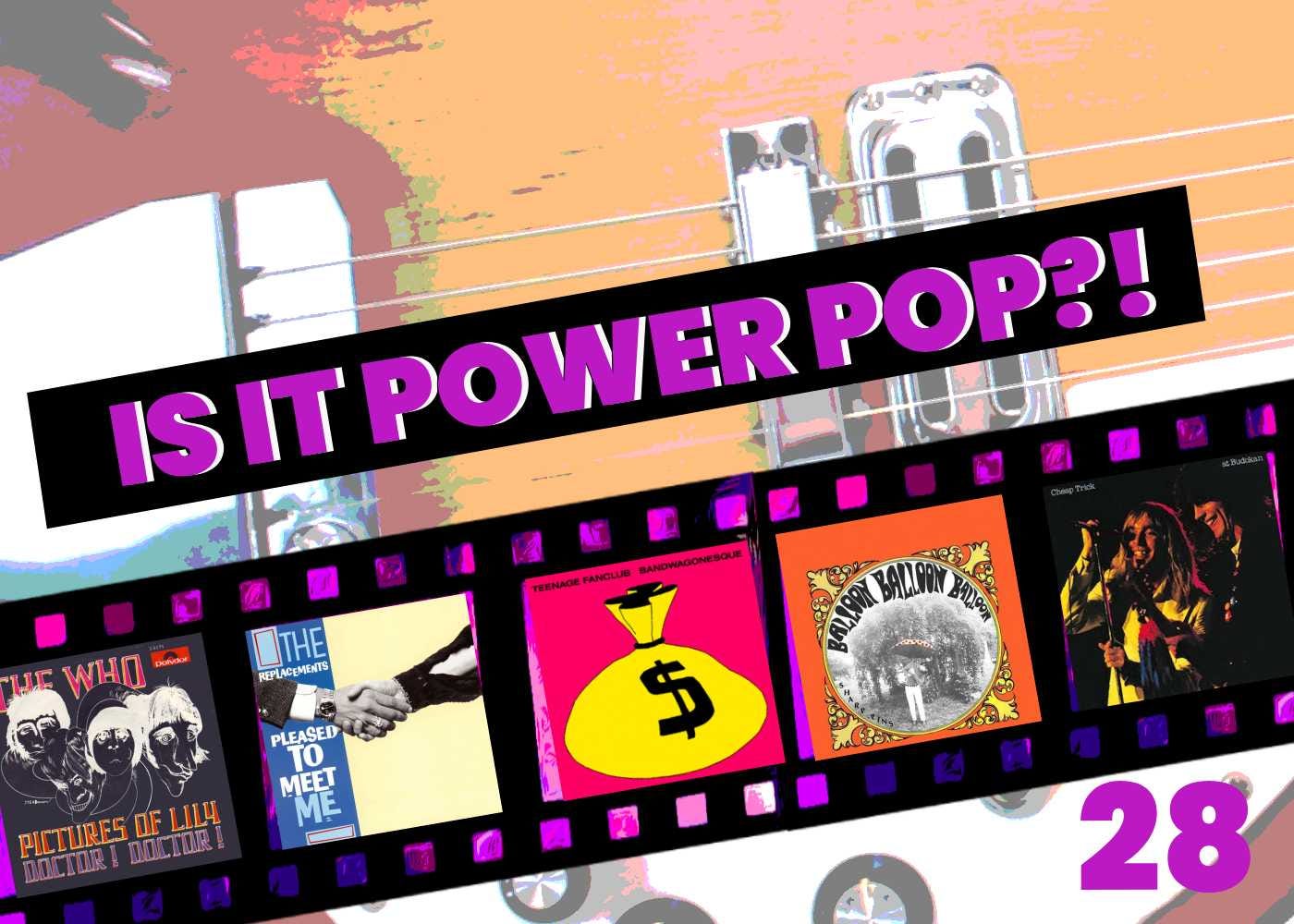
This is a guest post series about power pop featuring some of my favorite music writers. We’ll be sharing a new installment every few weeks or so (while supplies last). Full series here.
Is It Power Pop?
By natasha olson
Oh boy, power pop.
What brings us back to this ineffable subgenre? What makes it worthy of endless discussion and debate, even fifty years after its initial heyday? The truth is, if you’re looking in the right places, you’ll never run out of power pop to consume. Power pop is everywhere, if you want it.
People who love the genre—if you can even call it a genre—really love it. Loving power pop is a lifelong commitment to a sound and style that is notoriously hard to pin down. Power pop can be heard in any decade, from any part of the world, from many different genres. All you need is some catchy pop hooks, sunny melodies and an open mind.
Like many power pop lovers, I was a Beatles fan first, and when I ran out of Beatle music, I set out to find more of those harmonies and jangly guitars.
I guess I never stopped searching.
I felt power pop was made for people like me: always a bit out of step and always obsessed with the power of pop music.
This is a fantastic series because it highlights how subjective power pop is—each contributor offers slightly different perspectives and parameters. That’s what I find to be the most interesting aspect of this subgenre.
I personally think the definition of musical genres is entirely up to interpretation and rock and roll shouldn’t have rules—that’s what makes it fun. But that doesn’t mean I’m gonna go and pick some random, obscure tracks; I’m choosing my favorite songs that highlight the decade-spanning scope of power pop.
“Pictures of Lily” by The Who
Could you call this proto-power pop? After all, it was Pete Townshend that coined the term power pop, so maybe we should give him his due.
“Pictures of Lily” is power pop in its purest, simplest form. The sound captured here—the urgent, raw quality mixed with pleasant, catchy harmonies—is what so many power pop bands have sought to recreate for decades. You can find traces of The Who in many power pop bands that followed throughout the ‘70s. Pete Townshend thought that pop music peaked in the early to mid-‘60s and the more complicated it got, the more it became inaccessible. I think that philosophy rings true to many of the devoted power pop artists.
“I Want You To Want Me” by Cheap Trick
And, I mean specifically the live version of this track. The album version doesn’t do it for me, I need the immediacy of the live single. The initial impact of the screaming crowd, Robin Zander introducing the song: “I want you… to want… me!” And then the drums kick in. Don’t tell me you don’t get chills.
Cheap Trick’s Live at Budokan is probably the commercial peak for power pop and Cheap Trick was one of the most commercially successful power pop acts. Now, just because something is popular doesn’t mean we should immediately write it off; in my book, Cheap Trick deserved the recognition. I think power pop needs as much power as it needs pop. Budokan showed us that power pop bands don’t have to be saccharine: it’s loud, fast and the production makes it a little bit dirty.
“Alex Chilton” by The Replacements
What’s a better choice for a power pop song than one written about the man who perfected the genre himself? Alex Chilton, frontman of Big Star and one of the biggest cult icons in pop culture, has written some of the best power pop songs ever made. If power pop artists were never meant to be big stars, destined to reside in the fringes and become beacons for lost-soul music lovers like me, then Alex Chilton is power pop personified.
I have a deep love for misunderstood musicians, and The Replacements are one of my all time favorite bands. There’s a parallel to be drawn between the two: both artists who never saw commercial success and were not widely recognized in their own time. Paul Westerberg knew there was a little cultural cache in mentioning Alex Chilton’s name, as Big Star was experiencing a bit of an indie resurgence in the mid to late ‘80s.
“Star Sign” by Teenage Fanclub
The early ‘90s was certainly not the time for power pop. When grunge reigned supreme over the airwaves and MTV, Teenage Fanclub was making cute ‘60s-esque pop tunes with beautiful harmonies. This was not exactly en vogue, yet they somehow managed to score Spin’s Album of the Year for Bandwagonesque in 1992, much to Nirvana fans’ chagrin. I guess that speaks to the timelessness of power pop; it’s a genre that harkens back to the ‘60s but remains unstuck in time, relevant in any decade.
Teenage Fanclub’s earlier take on power pop is a bit more distorted and their later efforts suffered from a lack of teeth. A Catholic Education and Bandwagonesque remain two of the best and most interesting takes on power pop.
“Popafangout” by Sharp Pins
Did you think Anton Newcombe of The Brian Jonestown Massacre was the last American to sing with a British accent? Think again. Sharp Pins, the project of Chicago indie-savant Kai Slater, blends classic ‘60s jangle pop with a lo-fi, Guided By Voices-esque sensibility, and yes, he sings with a bit of a British accent.
His sound is familiar and his influences are obvious, but here’s the thing: the songs hold up on their own. Listen to “Popafangout” once and its catchy, hook-filled chorus spins around in your head for days.
Sharp Pins and their DIY contemporaries are my proof that power pop is everywhere and will never die. There’s something about hearing analog recording, complete with imperfections, that scratches the itch for a real, visceral experience—something that is few and far between in 2026.
Power pop is something we can dress up and down forever, and if it’s good, it’ll sound as refreshing as it did in ‘65. Sharp Pins does just that.
Give the algorithm a piece of your mind!
Previously On “Is It Power Pop?!”
Is It Power Pop?!

This is a guest post series about power pop featuring some of my favorite music writers. We’ll be sharing a new installment every few weeks or so (while supplies last). Full series here.

This made my Saturday morning. Power pop is a great genre; but mainly because the songs that make the lists of many are great songs. There’s a ton of terrible songs that are not saved by power pop trappings. All of the songs and bands you listed hit the mark.
Brilliant list.