

Hey! Ho! Let's Go Read!
Seven Must-Read Ramones Books

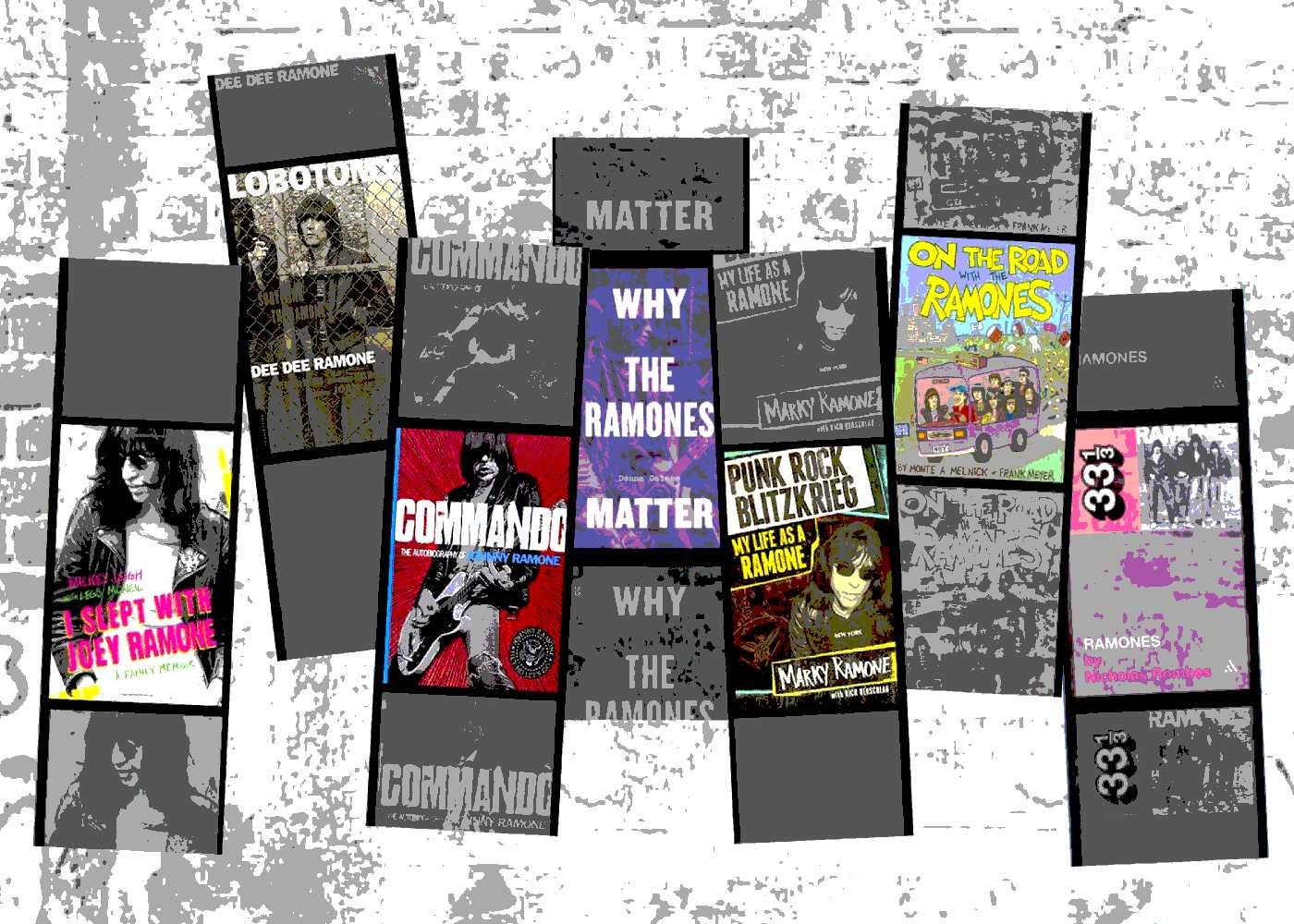
I’ve long been fascinated by the whole CBGB scene, but Ramones were always my favorite NYC band.
They were four leather-clad misfits with bowl cuts playing an irreverent brand of breakneck bubblegum music. This in-your-face response to the bloated arena rock dominating the airwaves in the mid-‘70s was so groundbreaking—so elemental, primal, urgent, undeniably hooky—that there really wasn’t even a name for it yet.
Writing fast songs about beating on brats with baseball bats, sniffing glue, and turning tricks at “53rd & 3rd,” Ramones stripped rock and roll to its snotty teenage core to launch an international punk rock revolution.
Their self-titled debut album was released in 1976, making this year the 50th anniversary…SO LET’S GO READ SOME RAMONES BOOKS!
Johnny Ramone’s autobiography Commando was my gateway read, an unflinching narrative that is as straight-ahead and unapologetic as his fierce downstrokes.
Next up was Dee Dee Ramone’s Lobotomy: Surviving The Ramones, the fantastical, inspiring, sometimes sad memoir from the erratic, beating heart of the band. I followed that with Punk Rock Blitzkrieg: My Life as a Ramone by Marky Ramone, their longtime second (and fifth?) drummer.
From there I expanded to the band’s inner circle starting with Mickey Leigh’s loving exploration of the complicated relationship with his older brother in I Slept With Joey Ramone: A Punk Rock Family Memoir. I also tackled the oral history On The Road With The Ramones by long-suffering tour manager Monte A. Melnick (with Frank Meyer).
After a break from Ramones books, I dove back in with Donna Gaines’ Why The Ramones Matter and Nicholas Rombes’ 33 1/3 series installment Ramones. Zooming out a bit further, I also recommend Carl Cafarelli’s Gabba Gabba Hey: A Conversation with The Ramones and Dee Dee’s unhinged Chelsea Horror Hotel: A Novel.
Like several camera angles trained on a single crime scene, these books—from band members, insiders, music journalists, and fans—offer unique perspectives on Ramones’ 22-year career and lasting legacy.
The band’s dysfunctional brotherhood is probably best summarized behind the scenes at their 1996 farewell extravaganza at the Palace in Hollywood, California.
After a star-studded show—featuring cameos from Dee Dee (who quit and was replaced by C.J. Ramone), along with members of Pearl Jam, Motörhead, and Rancid, among others—most of the Ramones apparently wandered off without even saying goodbye to each other.
This lack of basic camaraderie—often verging on outright disdain—is captured in Johnny’s brutally pragmatic quote from On The Road With The Ramones:
You don’t have to like everyone you work with.
Work with? That presents a fascinating contrast to their carefully-crafted “band as a gang” image. But the more you read about the individual members, the more you realize that on some tragically fundamental level Ramones had become a blue-collar T-shirt business after 2,200+ live shows and 14 studio albums.
That final show in 1996 might have been the end of an era for legions of devoted fans, but for the individual Ramones it amounted to simultaneous retirement parties (at best), or just another work shift (at worst). So, when it was over they clocked out and went their separate ways. At least fans got the live album We’re Outta Here!
The more I immersed myself in Ramones reading, the more I came to understand that it was the perfect way for this broken band of brudders to say ¡Adios Amigos!
There are no gold watches in rock and roll retirement, especially for underground heroes like Ramones.
But their self-titled debut did finally go gold in 2014…38 years after it was first released. And (Gabba Gabba) hey, they’re in the Rock and Roll Hall of Fame. Here was Dee Dee’s speech from that tense event that saw various Ramones factions keeping their distance at separate tables:
Hi, I’m Dee Dee Ramone and, uh, I’d like to congratulate myself and thank myself and give myself a big pat on the back. Thank you, Dee Dee. You’re very wonderful. I love you.
It doesn’t get more punk rock than that, but it’s too bad Joey didn’t live long enough to collect his statuette which the rest of the band left unclaimed on the podium.
Other recurring themes in these books include:
Joey’s huge, but constantly broken heart, mental and physical health issues, and his simmering hatred for Johnny (who stole and married his girlfriend, Linda).
Johnny’s militaristic control over the band, right-wing politics, and love of milk and cookies after shows.
Dee Dee’s self-destructive ways, artistic yearnings, and mental and emotional health issues.
Marky’s partying, eventual sobriety, and eating bugs for fun and profit.
Along the way you also catch glimpses of original Ramones drummer/producer, Tommy, who deserves a lot more credit for the band’s sound and image.
In the end, it all comes back to the timeless music.
Sadly, all four of the original Ramones—Joey, Johnny, Dee Dee and Tommy—died way too young, which makes these stories even more valuable for new and old fans. Thankfully, Marky, C.J., and generations of musicians inspired by Ramones are keeping their music and memories alive on stages and recording studios worldwide.
Pop culture was forever transformed when Ramones first formed in 1974. If something that musically earth-shattering isn’t worth the time it takes to read seven slim volumes, I don’t know what is.


Johnny's book was a surprisingly great read!