

oh the humAnIties*
The Struggle Is Real: Many More Questions Than Answers
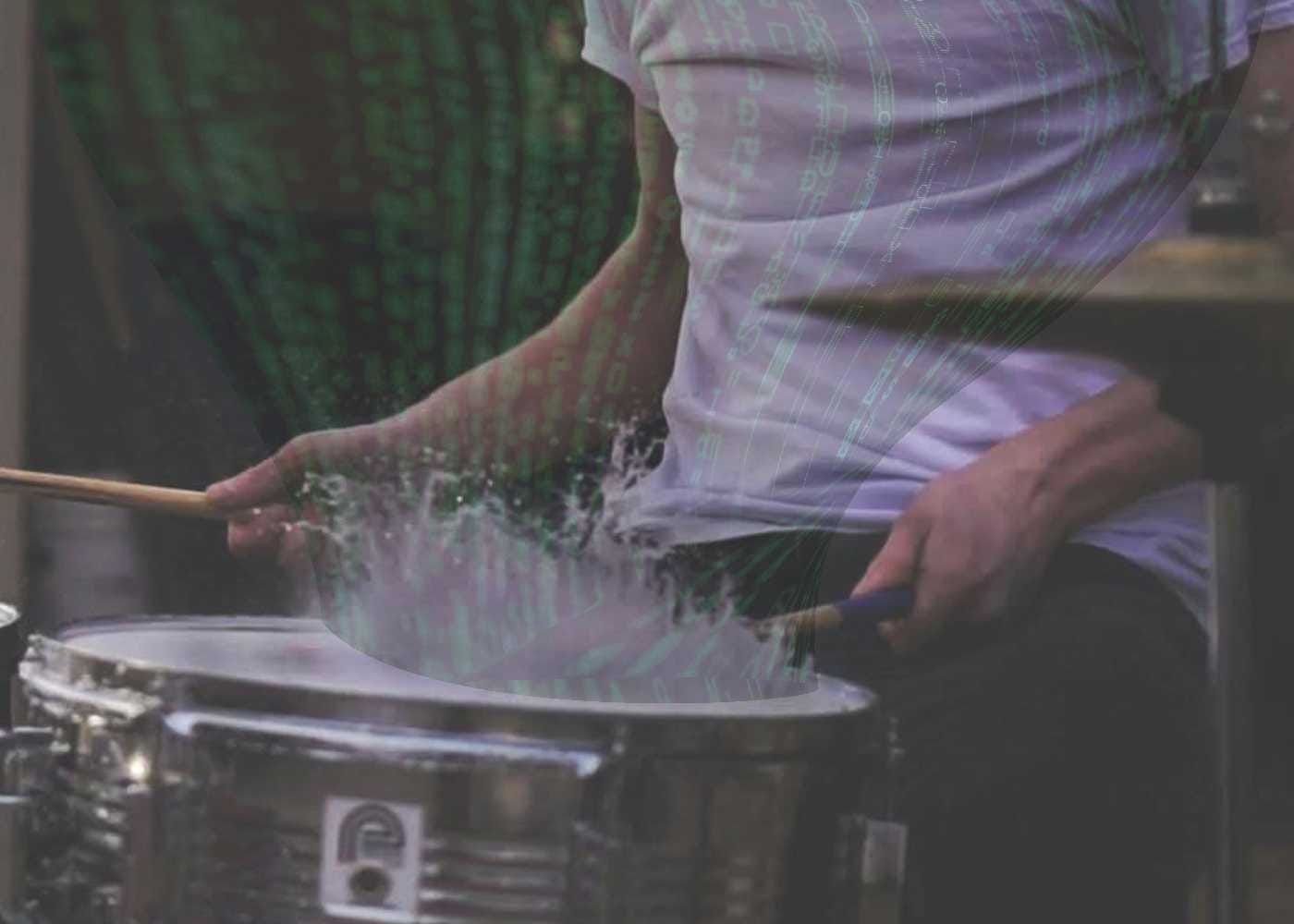
I’ve always had a complicated relationship with drumming.
As a kid, I definitely appreciated the percussive prowess of legends such as Ginger Baker, Ian Paice, and Neil Peart. Technical proficiency was what my small universe of music-loving family members and elementary school friends mostly focused on. I was more awed by early Keith Moon and Charlie Watts, Peter Criss, and Bun E. Carlos.
When punk rock entered my consciousness, I doubled down on drummers who—for all their undeniable talents—gave the impression that they were holding on for dear life, making it up in the moment, or pushing the songs until it felt like the wheels might fall off. Drummers who sounded very human to my young ears.**
The kinds of bashers my heavy metal-loving junior high friends ruthlessly mocked as hacks or amateurs. It became an important fork in the road for my own musical exploration and identity, but it also created a lifelong dissonance between the drummer I thought I was supposed to be and the kind of drummer I am.
I was never able to adequately articulate my feelings about all of this until I interviewed one of my early influences, Rat Scabies of The Damned:
The thing about technical players is that you’re always really impressed by their brilliance, until you go into the next club where there’s a very similar drummer doing very similar things. There’s no uniqueness in that. So, you end up with two schools. There’s [technical mastery], or you can try to push your imagination as far as it will go—which always sounds fucked up because it’s new and different because nobody has anything to compare it to.
I won’t put myself on the same level as Rat Scabies—and I’m sure not everyone will agree with his observation, which is fine—but that quote addressed many of the mixed feelings I had about my own drumming over the decades.
On some level, I have always been more attracted to struggle than mastery.
The collision of those tensions, combined with my attempts to mimic my heroes, led me to a style that is—for better or worse; often stubbornly—my own.
This has been top of mind because my longtime on-again/off-again musical collaborator Kevin Ridel recently unearthed a collection of lost demos from our ‘90s band Ridel High. Listening back 30 years later, I very clearly hear a younger drummer grinding the gears to keep up with external expectations and internal ambitions.
I hear him sweating every machine gun roll, tricky turnaround, and abrupt stop, hallmarks of the noisy alterna-pop sound that Kevin, guitarist Steve LeRoy, and I committed to muscle memory over countless rehearsals and live shows. My body still reflexively tenses as I listen to that long ago trio transitioning from part to part.
The thing that strikes me most about those old, often low-budget recordings is how alive they sound. This was the last full-time band I recorded with before embracing the click track, something I’ve relied on pretty consistently for recording ever since. So, the tempos on these pre-click recordings wobble and accelerate, but the music ebbs and flows in ways that sound like a conversation between the band members.
Don’t get me wrong, I’m thankful to the producer who encouraged me to address my excitable timing in the studio. It probably saved my job in an era when many A&R reps were quick to shout “You need to replace your drummer if you want to make it!” and product-minded engineers had their go-to studio aces on speed dial.
Loyalty be damned, this is the music business! (Conversely, if you ever wondered why one of your favorite bands’ 3rd or 5th album suddenly sounded sterile, check to see if they replaced their original drummer. It’s an interesting exercise. Tastes may vary.)
Pragmatically speaking, the click also saved many hours, endless frustrations, and countless thousands of dollars in expensive studio time. And it opened me up to beat mapping, loops, and punched fills that added to our sonic palette while further streamlining sessions. The results aren’t better or worse, they were just created using different approaches often made possible by our openness to technological advances.
But I do sometimes wonder at what point those altered backbeats stop being me and become collage (at best) or Steve-sourced triggers and samples (at the extreme).
That line of thinking can become a technophobe rabbit hole for me pretty quickly these days.
I recently re-read David Byrne’s 2012 semi-autobiographical How Music Works. In it, the quirky Talking Heads frontman and eclectic solo artist takes a close, personal look at how technology has shaped our relationship with music over the last 140 years:
The first sound recording was made in 1878. Since then, music has been amplified, broadcast, broken down into bits, miked and recorded, and the technologies behind those innovations have changed the nature of what gets created. Just as photography changed the way we see, recording technology changed the way we hear. Before recorded music became ubiquitous, music was, for most people, something we did.
I went back to Byrne’s excellent book after the recent outcry over the AI-generated band The Velvet Sundown. I was initially irked like so many other music writers and lifelong fans, but as the weeks passed I became aware of a quieter reaction bubbling up in my psyche: We’ve been slowly marching toward this reality for a long time.
I am in no way defending generative AI music and the many sneaky ways it’s being force-fed to us (I’ve had my own unexpected encounters), but I’m also not totally shocked that this is where we’ve ended up given how a lot of modern music is written, recorded, distributed, discovered, and consumed these days.
We now live in an era when an old school music blogger like myself has to pointedly ask bands and RTL contributors if they used generative AI to create all or most of what they submitted. But even that’s a slippery slope because these rapidly-advancing technologies have seeped into the very platforms and tools many of us rely on.
I go out of my way to avoid music, books, movies, even graphic art made with generative AI. It might be a function of my age and the art/artists I grew up admiring, but I’m mostly interested in the how and why of human expression—not just the end result. I still want stories about creative struggles more than instant gratification.
Which makes me wonder: How much of the modern art I consume was made using these tools without my knowing it? The questions don’t end there…
My Brain: “But a human being still came up with the initial concept and all of those complex prompts.”
Also My Brain: “Is the idea the most important part of art? Is the initial spark and the artist’s signature all that matters? What about the blood, sweat, and tears in between?”
My Brain: “I dunno. Ask Andy Warhol…”
Also My Brain: “Ouch.”
The lines get blurrier every day, and I’m not really interested in deputizing myself as a full-time AI cop. It forces me to ponder why I’m mostly okay with the technologies that got us here, but not these most recent quantum leaps.
“AI bad” feels overly simplistic when you consider the cancer research breakthroughs it has facilitated. On the other hand, LLM data centers apparently suck up an alarming amount of fossil fuel energy that could accelerate climate change.
Many are calling this a “bubble” that will ultimately turn AI into the next NFT. Others say that our precarious economy is being propped up by AI speculation and that the bubble bursting might send us spiraling into a recession worse than 2008.
Tech, science and economics dominate the scary AI headlines, but I can’t stop wondering what will become of the humanities, and—by extension—each of us.
Much as my brain demands black and white answers, none arrive.
Truth is, I’m not an early adopter.
It’s funny to consider now given how much valuable time I waste on my computer and smartphone, but I resisted embracing the internet in the ‘90s—even as many of my oldest writer/journalists friends went all in on digital publishing, making names and careers for themselves that continue to this day.
Same with social media. I mostly missed the MySpace era (outside of a few band pages), and many close friends were Facebook veterans by the time I finally signed up. Likewise with Twitter, which I always thought was the ugliest place imaginable (still do). I didn’t join Medium until I was overcome with fidgety pandemic boredom. I finally launched this Substack in January 2023.
Consequently, part of me wonders if I’m just repeating that pattern with my reluctance to accept generative AI in the arts. If nothing else, it seems like an interesting question to consider given my track record with emerging technologies.
I very clearly see the many ways AI is undermining the things I cherish and value most by presenting an existential threat to creators, further stripping what little humanity remains in our day to day, doomscrolling existence. But it also seems like many people are unaware, aren’t as bothered by it, or fully embrace it.
Perhaps the time-/resource-/cash-strapped masses accept generative AI for the way it is relentlessly marketed by the business and tech sectors—groundbreaking tools designed to make life easier by helping people be more efficient and productive.***
But are we potentially outsourcing the most meaningful parts of our daily lives? A recent study in the Harvard Business Review suggests that AI performance boosts come with a psychological toll:
While gen AI collaboration boosts immediate task performance, it can undermine workers’ intrinsic motivation and increase feelings of boredom…
I kind of get outsourcing your brain at a 9-to-5 job, but it’s hard to fathom doing that with my writing.
As with the evolution of recording technology, we got here by degrees—like a frog progressively being boiled in a pot of 1s and 0s. Or, as Ian Bogost astutely surmised in his article “Nobody Cares If Music Is Real Anymore” for The Atlantic:
Long before generative AI began its takeover of the internet, streaming music had turned anodyne—a vehicle for vibes, not for active listening. A single road trip with The Velvet Sundown was enough to prove this point: A major subset of the music that we listen to today might as well have been made by a machine.
A close friend and I followed similar music career arcs in the ‘90s. These days we’re raising our kids in the same tight-knit circle of friends, often fretting about what their future might look like. We also still rent plug-and-play rehearsal rooms or book occasional live shows for the old bands we reminisce about at backyard BBQs.
(Editor’s note: Decades later, I’m still literally banging drums with sticks. So, maybe take my AI observations with a grain of salt.)
Both of us work in industries under constant threat from generative AI. Whenever I steer our conversations to those topics he has a less reactionary perspective—one focused on how those technologies have the potential to further democratize the arts by giving voice to people who might not have the time, physical abilities, or resources.
Friend 1: “And aren’t those stories worth telling too?”
Me: “But at what I cost?”
In my mind, that’s the million dollar question humankind is debating. And I suspect that what we collectively decide now will profoundly impact the future of learning, artistic expression, work, and the very meaning of existence.
Another close friend is one of the most talented musicians I know. He’s defiant in his refusal to use generative AI in his writing and recording, but perfectly fine using it to create graphics for show promotion.
For him, the distinction seems to be clear—music is art, marketing is not:
Friend 2: “I never really liked making flyers and this saves me a lot of time.”
Me: “But isn’t that a slippery slope?”
Likewise, I have personally used AI to transcribe interviews. I asked the questions and wrote all of the resulting articles, but I did use cut-and-paste quotes from those transcriptions. Should I add an asterisk to my headlines? Publicly flog myself on livestream video? Make 30 more paper and glue collages as AI offsets?
I ran an early version of this essay by my two unnamed friends for feedback in case they felt misrepresented. Both thoughtfully doubled down on their underlying positions that this is our current reality, so we’d better embrace it.
One of them reiterated that he can now create a world class graphic in two minutes. The other compared AI resistance to a caveman banging two rocks together (which felt like a 2001: A Space Odyssey reference combined with a clever drummer joke).
The lines have been blurred in slow motion over the course of human evolution.
So, my internal (and sometimes external) debate rages on:
My Brain: Am I tilting at windmills?
Also My Brain: Am I valiant defender of human art or an analog dinosaur?
More Of My Brain: Am I refuting technology by romanticizing human struggle?
I don’t pretend to have the answers, but I do know what I like. For now, and very likely for the foreseeable future, it’s not the generic AI slop we’re being inundated with. Or, at least, the AI slop we even know about.
I fear that telling the difference will only get more difficult.
But where do we go from here?
*I did some Google searches for this essay and occasionally read the “AI Overview” that auto populates at the top of most results pages. I have no idea how accurate that information was or how much of it seeped into my perspective and writing.
**Interestingly, I have long admired drummers like DJ Bonebrake from X, Brendan Canty from Fugazi, and Dave Grohl from just about every Gen X alt rock band that still matters, precisely because they evolved from punk bashers into highly-skilled, and technically adept drummers. I have always loved Alan Myers from Devo precisely because of how mechanical his playing sounded. And I’m in awe of Glenn Kotche from Wilco because his drumming is so weird. I told you that my relationship with drumming is complicated.
***All em dashes are my own.


Thought-provoking piece, Steve. FWIW, I do use an AI transcription service (Otter) to transcribe my interviews — but I look at that as a rare example of AI actually making my life better, since transcribing is easily the most time-consuming and unrewarding part of my already poorly-paying job. (I still go over the transcription to make sure it's accurate, since a great many of the folks I interview either have accents or drop references that don't necessarily translate well.)
But as a writer, I would never in a million years use AI to actually write something. Just as I might use the "Smart Drummer" feature in GarageBand to construct a drum track — because I can't drum for shit — but I would never and use any sort of AI to write a song. I just find the creative process too stimulating and rewarding to cede that pleasure to our robot overlords.
Great piece Steve. I wonder how much of this has to do with time and effort and how we as a society are pushed to create content at a fever pitch. To learn an instrument, let alone master it, takes years and to tell someone that it'll take YEARS to see progress freaks them out. AI shortens that time of discovery, which i feel is so important. But what do i know? I'm just a dumb drummer ;)