

This is a guest post series about power pop featuring some of my favorite music writers. We’ll be sharing a new installment every few weeks or so (while supplies last). Full series here.
Is It Power Pop?
By wordsworthesq
I didn’t find my way to power pop. It found its way to me.
My first exposure was in my formative years via Canadian radio staples like Michel Pagliaro’s groundbreaking “Lovin’ You Ain’t Easy” and April Wine’s “Tonite Is a Wonderful Time to Fall in Love.” But the real baptism occurred during the new wave era, when I swooned over singles by everyone from The Go-Go’s and The Monroes to Josie Cotton and, yes, .38 Special.
I realize some of those artists aren’t considered power pop per se, but I’ve never concerned myself with who is. It’s always been what is.
For me, power pop has always been a shifting combo of several factors.
For one, it might be reminiscent of Beach Boys, Beatles, Byrds, or Barrett’s early Floyd singles (big shout out too to Jackie DeShannon, my Queen of proto-power pop). I want to hear glorious harmonies. And I want energy—not just in the song but also imparted to me.
But more than that, I want a hook that nearly consumes the entire song, if not my attention. I always struggle to explain what I mean, but a power pop hook has a soaring, almost spiritual quality with deep emotional resonance. And it is, invariably, a monster of an earworm, one that necessitates medical assistance to dislodge (though why you would baffles me).
I thought about making a case for my qualifiers and tastes in many ways, everything from a survey of proto-power pop to an all-Canadian assortment of confections.
But heeding our lovely host’s exhortation to have fun, I landed on a particular era of power pop—the late ‘80s and early ‘90s, just before grunge hit. For a moment, I thought we were witnessing a power pop breakthrough as artists like Michael Penn and The Rembrandts took their ‘60s-inspired singles into the Billboard charts.
But it proved to be a bug, not a feature. Which is why I am making it a feature—a set of songs that promised a kind of international pop overthrow before grunge came roaring in with teen spirit to spare.
Give the algorithm a piece of your mind!
“Falling Away” by Richard X. Heyman
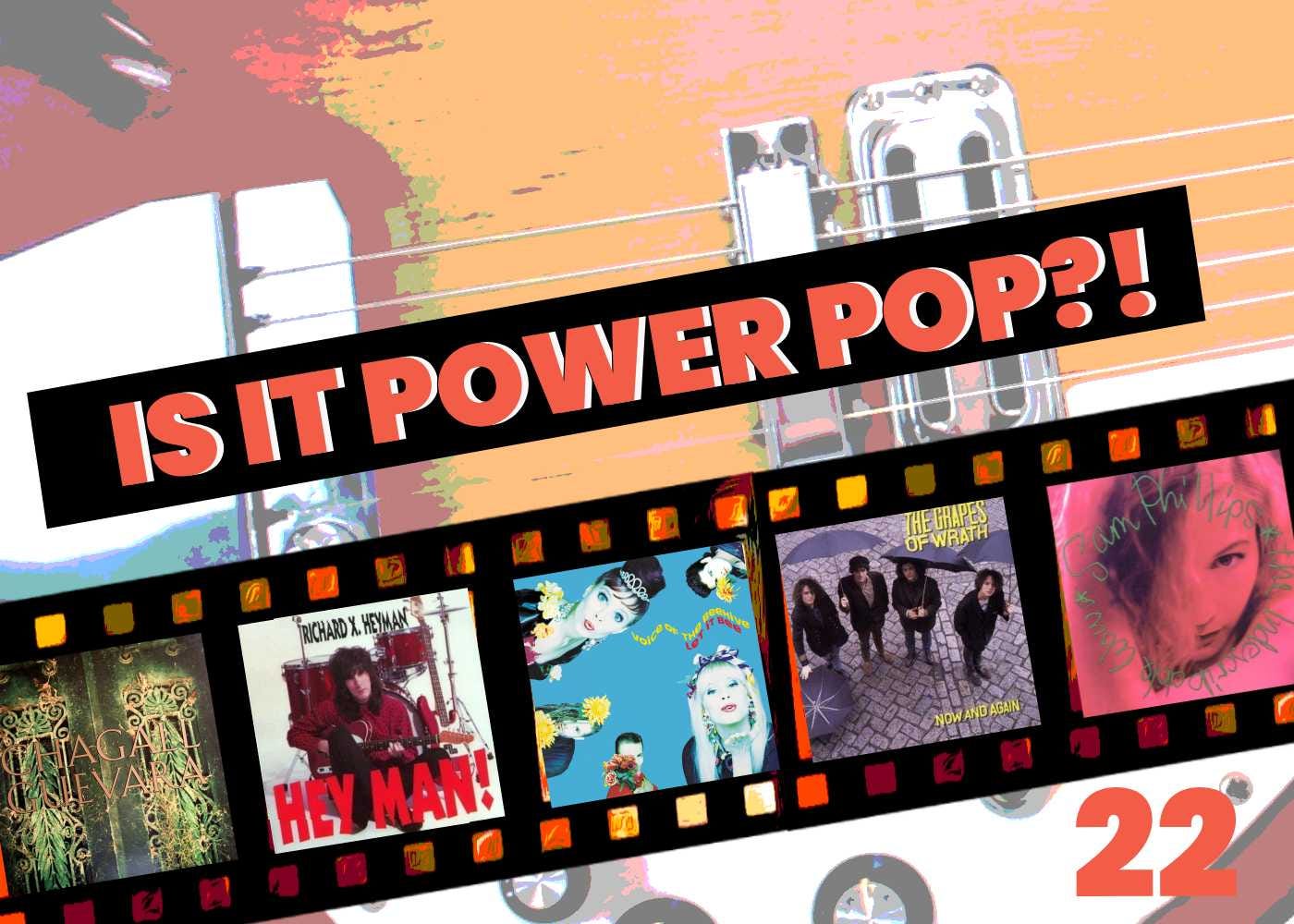
I’m coming in hot with my first choice. Heyman got his start with The Doughboys, a New Jersey band whose 1967 single, “Rhoda Mendelbaum,” is a grubbier take on the baroque rock that The Left Banke took to the bank. In ’91, a peak year for the kind of power pop I mean to highlight, he released Hey Man!, his lone major label album, which included this single. Produced by the legendary Andy Paley, “Falling Away” is delightfully Beatles-esque, with Heyman playing most of the instruments and stacking his voice in harmonies that brings no less than Todd Rundgren to mind. It is delightful, and so is the rest of the album. If I had a genie who could grant three wishes, one would be to have Hey Man! pressed on vinyl.
“I Walk The Earth” by Voice of the Beehive
Two sisters—Tracey Bryn and Melissa Brooke Belland—whose father was a member of The Four Preps, cross the Atlantic, join up with some UK musicians, including the former drummer from Madness, and make what I believe is one of the best power pop albums of all time, 1988’s Let it Bee. Corny title from a band with a corny name, but “I Walk The Earth” will disabuse you of any notions you might have formed based on that info. This should-have-been single has so much vitality to it that reminds me of another pair of punk-pop-leaning siblings, the Davies brothers, but with far less acrimony. It starts with divine harmonies, revs up with a slashing guitar riff, and hits the road, inviting you to grab your pack and come along. Each time Bryn and Brook Belland hit that glorious chorus, I’m not walking along with them; I am floating into the stratosphere.
“Stay” by The Grapes of Wrath
The Grapes never broke anywhere but Canada, where Canadian content regulations helped them score a couple of hits with their classic 1989 album Now and Again, produced by Anton Fier. “Stay” is one of that album’s many deliriously catchy highlights. With its chiming guitars and bittersweet melody, it hearkens back to the pop pleasures of, say, Jackie De Shannon, Moby Grape, and Gene Clark’s contributions to The Byrds, in particular “Feel a Whole Lot Better.” In fact, the band capture that era’s signature jangle so well that when I first heard Now and Again, it sounded like an artifact awaiting rediscovery. In many ways, it still is.
“I Don’t Know How to Say Goodbye to You” by Sam Phillips
A refugee from the Christian music scene, Leslie Phillips changed her name and started over on Virgin Records with 1988’s The Indescribable Wow, a pop album nonpareil. This is one of many highlights, a perfect power pop song not just in terms of its harmonies and hooks but also its conceit: figuring out how to walk away from someone who, based on all available evidence, doesn’t love you as you truly, madly, deeply love them. The irony is how assured and insistent this song is, from that steady, accentuated beat to Phillips’ multitracked harmonies. She may not know how to leave, but she does leave quite an impression.
“Escher’s World” by Chagall Guevara
Ending on a high note, we have some more refugees from contemporary Christian music whose homonymous ’91 major label debut contained this corking, riotous little gem that I just want to shout along with. Whereas most power pop is suffused with longing, this is about waking up to a world where up is down, down is out, and out is in. In other words, a world very much like ours. The only way to make sense of the calamity and chaos is to listen to more power pop. And this, despite its placement in my list, is a great place to start.

Previously On “Is It Power Pop?!”
Is It Power Pop?!

This is a guest post series about power pop featuring some of my favorite music writers. We’ll be sharing a new installment every few weeks or so (while supplies last). Full series here.

Pagliaro’s “Lovin’ You Ain’t Easy” is slated for a future episode of 1,000 Greatest Misses podcast . “I’ve never concerned myself with who is. It’s always been what is.” Same!
Sam Phillips has perhaps the most surprising movie role of all time—the power popper playing the sociopathic mute in Die Hard With a Vengeance.